
How to Use Claude, GPT and Gemini From One Account

Create one account, pick a model, send your prompt. One login and one credit balance in Moleculs give you Claude, ChatGPT, Gemini, Grok, DeepSeek and other models in the same interface. You don't need a separate subscription for each vendor.
Below: your first request, splitting one task between Claude and GPT, what each run costs in credits, and where this setup stops being useful.
The short answer: one account, many models
An aggregator puts one login in front of models from several vendors. You don't need separate OpenAI, Anthropic and Google accounts. You pick a model for each request, and every run comes out of the same balance.
As of October 2026, the full model catalogue lists text models from OpenAI, Anthropic, Google, xAI, DeepSeek, Moonshot AI, Z.ai, Alibaba, Meta and Perplexity, plus image, video and audio models. The cost per run in credits is shown next to each model, so you know what a request costs before you send it.
Why separate AI subscriptions get messy fast
Every vendor has its own plan, usage caps and billing date. Three subscriptions mean three renewals, three sets of limits and three chat histories to dig through when you need last week's answer.
Switching costs you too. When Claude's answer looks off, you want GPT's opinion now, not after you log into another app and paste the context back in. So you skip it and stay with whichever model you opened first.
A quick check: list the AI subscriptions you paid for last month and how many days you used each one. If one sat idle for most of the month, you paid for access you didn't need.
Official apps vs an aggregator: what changes and what doesn't
Claude Opus 5.5 is Anthropic's model and ChatGPT-5.5 is OpenAI's. Moleculs doesn't build or retrain them. It gives you access to them through its own interface.
What changes:
- Interface and settings. Features that vendor apps add around the model don't carry over, and settings may differ. Don't assume a model here behaves exactly like the vendor's official app.
- Billing. One subscription, and each run is drawn from your credits.
- Switching. You can send a prompt to Claude and the same prompt to Gemini without changing accounts.
If your work depends on a feature built into a vendor's own app, keep that app.
Step by step: your first request in Moleculs
- Try it as a guest. You can send one request to a text model without signing up. After that you need an account.
- Sign up with email, Telegram or a social login. The free plan includes 5 credits. That covers one Claude Haiku 4.5 run (5 credits) or five runs of DeepSeek V4 Flash (1 credit each).
- Pick a model. Its cost per run is shown next to its name. Start cheap. Move to Claude Opus 5.5 (20 credits) or ChatGPT-5.5 (28) only when the cheaper answer isn't good enough.
- Write the whole brief into the prompt. There are no saved assistants, so the role, rules and context go into each request.
- Attach files if you need them. As of October 2026, Claude models take up to 20 images per request, Gemini models up to 16, and ChatGPT models up to 10.
- Check the answer. Did it answer your question, in the format you asked for, without facts you can't verify?
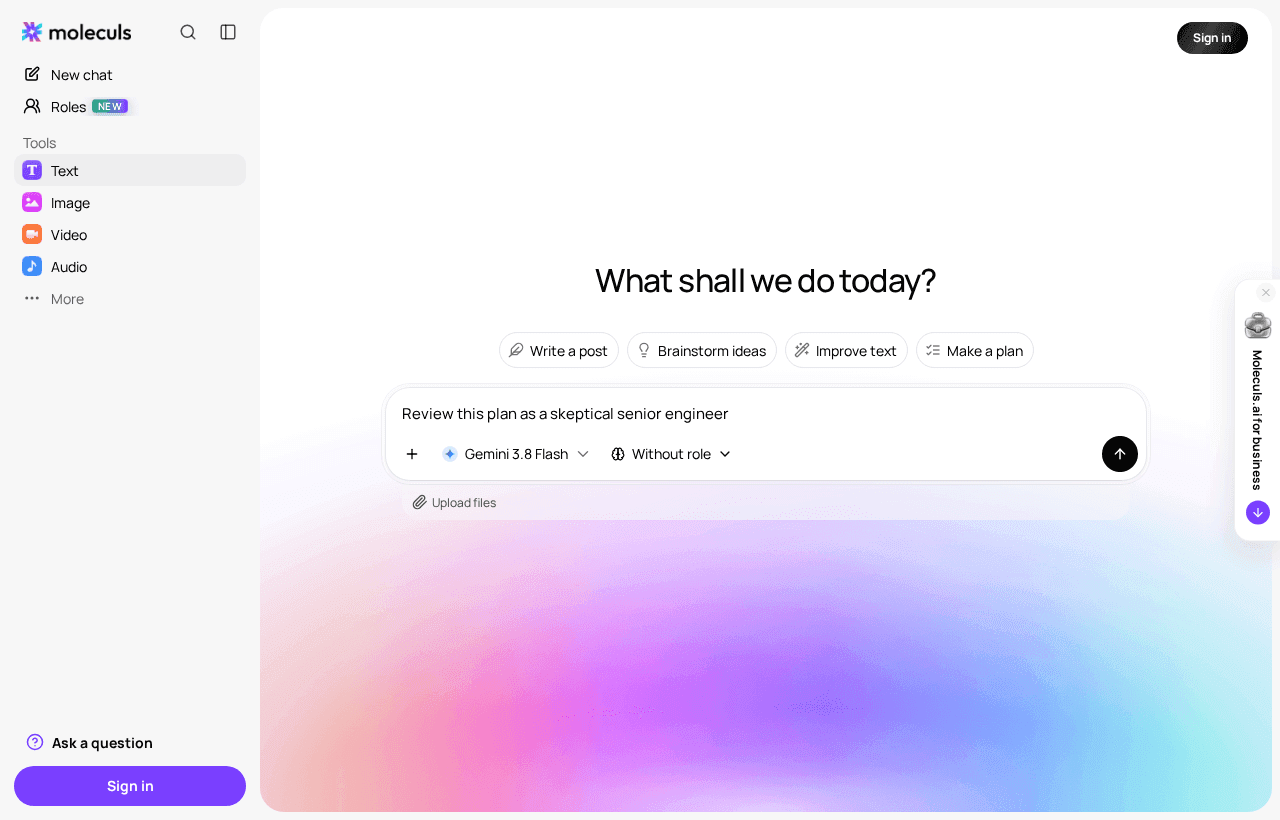
Sending a one-line rephrase to a 48-credit model like ChatGPT 6 Astra or Claude Fable 5.1 drains your balance fast. A 1-2 credit model handles that kind of task.
Using Claude and GPT together on one task
One model drafts, a model from another vendor critiques, and the first one revises. The models are trained differently, so the second pass can catch what the first one missed. There's no side-by-side window. You switch models between rounds and paste the previous answer in.
Round 1: draft with Claude Opus 5.5
Role: You are a senior backend engineer writing for a team lead.
Task: Write a plan to move our blog from WordPress to a static site generator.
Format: Numbered steps, each with an owner role and a time estimate. Under 300 words.
Constraints: Two engineers, two weeks. Keep all existing URLs. No paid plugins.Round 2: critique with ChatGPT-5.5
Role: You are a skeptical reviewer who has run three CMS migrations.
Task: Review the plan below and list its three weakest assumptions.
Format: For each: the assumption, why it may fail, one test that settles it within a day.
Constraints: Don't rewrite the plan. Don't add new steps.
Plan: <paste Claude's answer>Round 3: revise with Claude
Switch back and send: "Here is your plan and a review of it. Update the plan to address points 1-3. Mark every change with [changed]."
Three rounds with flagship models cost 20 + 28 + 20 = 68 credits. The same loop with Claude Sonnet 5 and ChatGPT 6 Sol costs 30. Run the cheaper pair first, and bring in the flagships only if the review finds structural problems. To see what a critique round returns, run the reviewer prompt on a sample plan.
You're done when every point from the review has been fixed or rejected with a reason. If the text is going to be published, check it against the signs of AI-written text first.
Which model for which job: a quick comparison
Prices are per run, as of October 2026.
| Job | Model | Credits | Why this one |
|---|---|---|---|
| Quick drafts, rewrites | DeepSeek V4 Flash, Gemini 3.8 Flash | 1, 2 | Among the cheapest per run |
| Everyday writing | Claude Sonnet 5, ChatGPT 6 Sol | 10, 10 | Same price, two vendors for a draft-and-review pair |
| Complex reasoning, code | Claude Opus 5.5 | 20 | Anthropic's flagship for reasoning, code and long agentic tasks |
| Second opinion on a Claude draft | ChatGPT-5.5 | 28 | Different vendor; takes images, video, audio and files |
| Video or audio as input | Gemini 3.1 Pro | 12 | Takes video, audio, files and up to 16 images |
| Long documents | Kimi K3 | 15 | 1M-token context |
| Web research with sources | Perplexity Sonar Deep Research | 8 | Cites its sources |
Use the table as a starting point. Take three real prompts from your own work and run them on two candidate models. Compare the answers on factual accuracy, whether the format matches your request, and how much you'd need to edit. For everyday writing you can start with the AI text generator.
How credits work and how to keep costs predictable
There's one unit: the credit. Each model has its own cost per run, shown in the catalogue and next to the model name. Your quota refreshes every paid period. As of October 2026, paid plans start at 1,000 credits a month. Current prices are on the pricing page.
For scale, 1,000 credits buys 50 Claude Opus 5.5 runs, 200 Claude Haiku 4.5 runs or 1,000 DeepSeek V4 Flash runs.
- Draft cheap, finish expensive. Get the structure right on a 1-2 credit model, then polish with a flagship.
- Put all the context in the first request. A vague prompt on ChatGPT-5.5 that needs two follow-up rounds costs three runs instead of one.
- Price a loop before you start. Multiply the number of rounds by each model's run cost.
What Moleculs doesn't do
- It doesn't build models. Answer quality depends on the vendor's model, so if Claude gets something wrong, it can get it wrong here too.
- There's no side-by-side comparison and no automatic chains. Each request goes to one model, and you switch models yourself.
- There are no saved assistants or templates. Keep your prompt skeletons in a notes file.
- It works through the interface only. There's no mobile app and no way to connect your own code. For that, use the vendors' developer platforms.
- It doesn't sell vendor accounts or help anyone get around vendor rules.
Beyond text: images, video and audio from the same account
The same balance covers other media. To generate images with AI, the cheapest priced options are GPT Image 2.5 Flare and GPT Image 2.5 Sunburst at 6 credits each. Ideogram v3 (14) is made for typography and posters, and Seedream v4.5 (13) for photorealism up to 4K. Nano Banana Pro (64) takes up to 14 input images. Test a prompt on a 6-credit model before you spend 64.
Video models include Veo 3.1, Kling 3.0 with multi-shot and a 4K mode, and Seedance 2.5 for clips up to 30 seconds with sound. Video runs cost more than text, so check the catalogue for the current price. Before your first clip, read how to generate AI video.
For audio there's Suno V6 for music, ElevenLabs Speech-to-Text for transcription with speaker separation, and ElevenLabs Sound Effects for effects from a text description.
Frequently asked questions
Related articles
 AI explained
Gemini vs Claude for Long Documents: Which Model Reads PDFs Best
We compare Gemini, Claude, Grok and Kimi on long reports, contracts and scanned PDFs. Includes a selection table and a test you can run on your own file.
 Model guides
Claude vs ChatGPT: Which One to Choose for Writing, Code and Work
We compare Claude Opus, Sonnet and Haiku with ChatGPT 5.5 and 6 on writing, code, file inputs and cost per run, so you can pick one for your own tasks.

Corporate access to AI models
Invoice for legal entities, centralised payment, priority support
- Access to ChatGPT, Gemini, Grok, Claude and DeepSeek
- Prompt library and shared access inside the team