
How to Write a Cold Email with AI: Steps, Prompts and Examples

A model can draft a cold email in seconds. It can't know why this particular person should care this week. So the work splits in three: you collect five facts (who, why now, what you offer, proof, what you ask), the model turns them into a short draft, and you edit that draft by hand before it goes out.
This guide gives you the workflow, a prompt to copy, an editing checklist and a before-and-after example. The prompt follows the usual role, task, format and constraints pattern. If that pattern is new to you, read how to structure a prompt first.
What AI does well in cold email, and what you still have to do yourself
A model is good at:
- turning rough notes into short, plain sentences;
- writing eight subject lines in one go;
- rewriting one base email for each prospect when you give it the details;
- summarizing a company's recent public news, if the model has web search.
You still own the parts that get replies: who to email, why now, proof from your own clients, and checking every fact. If you give a model no inputs, it fills the gaps with flattery and made-up details, like "impressed by your recent growth" sent to a company that just cut staff.
Before you prompt: the inputs a model needs
Write one line for each input:
- Prospect: name, role, company, what they're responsible for.
- Trigger: a specific reason to write now that you can check, such as a job post, a funding round, a launch or a talk.
- Offer: what you do, in one sentence and in their terms.
- Proof: one result for a similar client, with a number if you have one.
- Ask: one small next step, such as a 15-minute call or a yes/no reply.
The test: if you can't fill in the trigger or the proof, don't prompt yet, because the model will invent them. If your offer won't fit in one sentence, fix that first. You can sharpen your offer with an AI business plan.
Step by step: from prospect research to a first draft
- Research, 5-10 minutes per prospect. Ask a search-backed model for the company's public news from the last three months, with links. Open every link and keep one fact you've checked yourself.
- Fill in the five inputs in a text file, one block per prospect.
- Run the prompt below. Do one prospect per run until the output is consistent.
- Ask for two versions with different openings. Two are easy to compare. With ten, you start skimming.
- Edit by hand, then read the email on your phone. If you have to scroll, cut.
A common mistake is to paste in the whole LinkedIn profile. The model then grabs a random detail, like the prospect's college. Give it one trigger and nothing else about the person.
You'll know it worked when a stranger can tell from the first line why you wrote to this person and not to 500 others.
A cold email prompt you can copy and adapt
Role: You are a B2B sales rep who writes short, plain emails to busy people.
Task: Write a cold email to {name}, {role} at {company}.
Trigger: {e.g. "posted a job for a customer marketing manager last week"}
Offer: {e.g. "we film and edit 2-minute customer case study videos"}
Proof: {e.g. "a SaaS client used three of our videos in sales calls in month one"}
Ask: {e.g. "Worth a 15-minute call next week?"}
Format: Plain text. One subject line, then the body. Body under 90 words, at most 3 short paragraphs.
Constraints:
- Open with the trigger, not with me or my company.
- No compliments, no "I hope this finds you well".
- Do not add any fact that is not in this brief.
- Do not use: leverage, synergy, cutting-edge, elevate.
- End with the ask as a single question.Two lines do most of the work. "Do not add any fact" guards against invented personalization. The word limit is there because models write long by default.
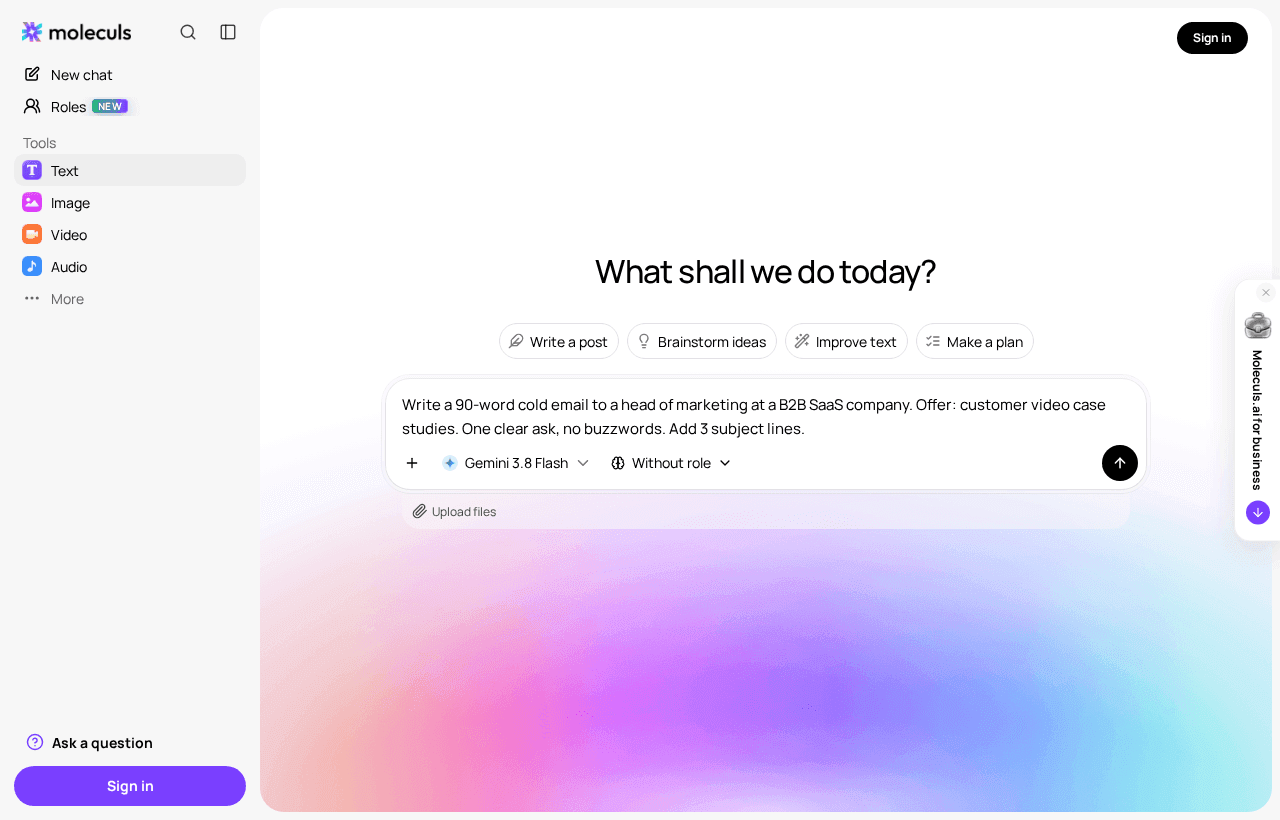
Before you plug in a real prospect, you can run a sample 90-word brief and see how a model handles the length and tone limits.
Editing the draft: cutting filler, AI tells and fake personalization
Go through every draft with this checklist:
- Delete the first sentence if it's about you or a pleasantry. The real email often starts on line two.
- Cut the AI tells: "I wanted to reach out", "in today's competitive landscape", "not only... but also", three adjectives in a row.
- Run the swap test. Put a competitor's name in place of the prospect's company. If the sentence still works, it isn't personal.
- Check every claim: your numbers, client names, anything said about the prospect.
For a second pass, give the model a narrow instruction:
Rewrite this cold email shorter and plainer. Remove flattery and generic openers. Keep one ask. Then write a two-sentence follow-up for day 4.Stop after two or three rewrite rounds. After that, the model starts sanding off the specifics, so finish the edit yourself.
Subject lines and follow-ups: generating variants without spamming
Ask for subject lines in the same chat so the model sees the email:
Write 8 subject lines for the email above. 2 to 5 words each.
Mention {trigger} in at least 3. No "Re:", no emojis, no all caps,
nothing the email doesn't deliver.To choose one, ask two questions. Would you open it from a stranger? Does it match the body? A misleading subject line hurts deliverability, and in some countries it's also a legal problem.
Send two or three follow-ups at most, a few days apart. Each one should add something: a short example, a new angle, or a polite "should I close the loop?". Stop after any reply, including "no". Variants are for testing on small batches. Three versions of the same pitch to one person is still spam.
Which model for which job: research, drafting, rewriting at volume
Research needs live search and sources. Drafting needs a model that keeps to your constraints. Rewriting at volume needs a low cost per run. Any general AI text generator covers drafting and rewriting. For research, only trust facts you can open and check yourself.
| Job | What to check | Models in Moleculs (credits per run, October 2026) |
|---|---|---|
| Research | Live search, cited sources | Perplexity Sonar (2), Perplexity Sonar Deep Research (8), Perplexity Sonar PRO (15) |
| First drafts | Keeps the word limit, adds no facts | Claude Sonnet 5 (10), Claude Opus 5.5 (20), ChatGPT-5.5 (28) |
| Rewriting per prospect | Low cost, consistent output | Claude Haiku 4.5 (5), Gemini 3.8 Flash (2), DeepSeek V4 Flash (1) |
Prices change, and the current cost is shown next to each model. To choose a drafting model, run the same brief through two models and score each on three checks: under the word limit, no invented facts, opens with the trigger. Keep the one that passes all three. A failed Claude Opus 5.5 draft costs 20 credits, so tune the brief on a cheaper model first.
Before you hit send: accuracy, consent rules and deliverability basics
Accuracy. Trace every fact to a source you opened. Check the spelling of the name, the job title and the company.
Consent. The rules depend on where your recipient is, not on which tool wrote the email. In the US, CAN-SPAM requires accurate sender details, an honest subject line, a postal address and a working opt-out. In the EU and UK, GDPR and the local e-privacy rules apply, and some countries require consent even for business addresses. Check before you email a new market.
Deliverability. Set up SPF, DKIM and DMARC. Send from a separate domain or subdomain and raise volume gradually. Keep the first email in plain text with one link at most. If bounces climb, stop and clean the list.
Before and after: a generic AI email vs a briefed one
Prompt: "Write a cold email selling video case studies to a SaaS marketer."
Subject: Elevate Your Marketing with Compelling Video Stories
Hi Sarah, I hope this email finds you well! I came across your impressive profile and was blown away by the amazing work your team is doing at Acme. In today's competitive landscape, video content is more important than ever. Our cutting-edge solution helps companies like yours leverage authentic customer stories to boost conversions. Open to a quick chat?
Same task, with the five inputs and the prompt above:
Subject: proof for your new hire
Hi Sarah, saw Acme is hiring a customer marketing manager. Whoever takes that seat will need customer proof, fast.
We film and edit 2-minute customer case study videos. A SaaS client used three of them in sales calls within their first month.
Worth a 15-minute call next week to see if that fits the new hire's first quarter?
The second email opens with something that happened at Acme, makes one claim you can check and ends with one question. Swap in a competitor's name and the first line is false, so it passes the swap test. The same model wrote both emails. Only the brief changed.
Frequently asked questions
Related articles
How to Write AI Prompts: the Five-Block Formula
A five-block prompt formula with before-and-after examples, format-specific rules for images, video and audio, and ready-to-copy templates.
 Prompts
AI Image Prompts That Actually Work: Structure and Examples
A six-part prompt structure, before-and-after examples for photos, posters and product shots, and how to adapt one prompt for Midjourney, Flux or Ideogram.
How to Generate Video with AI: A Step-by-Step Guide
A practical walkthrough of AI video generation: scene setup, prompt structure, image-to-video, camera control, sound, upscaling and the mistakes that ruin a clip.

Corporate access to AI models
Invoice for legal entities, centralised payment, priority support
- Access to ChatGPT, Gemini, Grok, Claude and DeepSeek
- Prompt library and shared access inside the team