
Marketing Prompt Templates: AI Copywriting Prompts for Ad Copy

Below are copy-paste prompt templates for search ads, social ads, landing pages, emails and short video scripts, plus the brief structure that makes them fit your product. Every template has slots in square brackets. Fill them with real facts about your offer, and the output stops sounding like every other ad in the feed. If you'd rather start from a dedicated page, there's an AI ad copy generator for that.
The templates work in any capable text model.
Why most AI ad copy sounds the same, and what a good prompt fixes
Ask a model to "write an ad for my meal-prep service" and it fills every gap with the most average phrasing it knows: "delicious", "hassle-free", "take the stress out of dinner". It doesn't know your customer, your price or what your competitors already say, so it guesses the middle.
A good prompt gives the model facts it can't guess and bans the defaults. Test any draft this way: swap your brand name for a competitor's. If the ad still works, the prompt was missing specifics.
The anatomy of a marketing prompt: role, audience, offer, constraints, format
Every template below uses the same skeleton. Copy it into a doc and fill it in once per product:
ROLE: You are a performance copywriter for [industry] brands.
AUDIENCE: [who they are, their situation, what they've tried, main objection]
OFFER: [product, price or deal, one proof point, call to action]
TASK: Write [number] [asset type] for [platform and placement].
CONSTRAINTS: [character limits, banned words, claims we can't make]
FORMAT: [numbered list or table, character count after each line]Filled in for a meal-prep delivery service:
ROLE: You are a performance copywriter for food delivery brands.
AUDIENCE: Working parents with kids under 10. They tried meal kits
and gave up because of the chopping. Objection: "it's expensive".
OFFER: Ready-to-heat family dinners, 5 meals a week, delivered Sundays.
Proof: dinner on the table in 10 minutes. CTA: "See this week's menu".
TASK: Write 10 Google Ads headlines for a search campaign.
CONSTRAINTS: Max 30 characters each. No exclamation marks.
Never use: delicious, hassle-free, revolutionary.
FORMAT: Numbered list, character count in brackets after each line.Most people slip on the AUDIENCE slot. "Busy people" gets you generic copy. "Parents who quit meal kits because of the chopping" gets you an angle. If your notes are messier than this, turn a rough idea into a structured prompt first, then edit the slots by hand.
Ad copy templates: search ads, social ads and retargeting variants
Paste the AUDIENCE and OFFER lines from the skeleton above each template.
Search ads
Write 10 headlines (max 30 characters) and 4 descriptions
(max 90 characters) for a Google Ads responsive search ad.
Each headline takes a different angle: benefit, objection, proof,
price, specific number. No fake deadlines.
Show the character count after each line.Social ads
Write 3 Meta ad variants. Each variant: primary text (the first
125 characters must work on their own), headline (max 40 characters),
call-to-action button text.
Variant 1 opens with a problem, variant 2 with a specific result,
variant 3 with a line a real customer might say.
Use only facts from the OFFER block. Do not invent numbers.Retargeting
These people visited [page] but didn't buy. Likely objection: [objection].
Write 5 short ads (max 90 characters) that answer this objection
with [proof]. Don't reuse the main ad's headline: "[headline]".The character counts a model gives you are approximate. Paste the final lines into a counter before you upload them.
Templates for landing pages, product descriptions and email sequences
For long formats, put the structure in the prompt or you'll get one wall of text. The same approach works when you write marketing content with AI beyond ads.
Write a landing page for [product]. Sections in this order:
headline (max 10 words), subheadline (max 20 words), 3 benefits
with one sentence of proof each, how it works in 3 steps,
an answer to "[objection]", final CTA.
Plain language. No section over 60 words.Write a product description for [product] in 80-100 words.
First sentence: the problem it solves. Then 3 specifics
(material, size, use case). End with who it's NOT for.Write a 3-email welcome sequence for new subscribers to [brand].
Email 1 (day 0): deliver [lead magnet], one tip.
Email 2 (day 2): customer story built on [fact].
Email 3 (day 5): offer [deal], answer "[objection]".
For each: 3 subject lines (max 45 characters), body under 150 words.Keep the "who it's NOT for" line. It pulls the model away from pure praise, and the copy reads as more honest.
Social media templates: hooks, captions and short video scripts
Give me 15 opening hooks for a short video about [topic] for [audience].
Max 10 words each. Mix: question, bold claim we can back with [fact],
common mistake, before/after. Mark the 3 you'd test first.Write a 30-second video script for [product]. Table with columns:
seconds, what's on screen, voiceover. Hook in the first 2 seconds,
one product benefit only, CTA in the last 3 seconds.For captions, reuse the hook template and add: "first line under 80 characters, one question to the reader, max 5 hashtags". One limit to know: the model can't see what's trending on a platform this week. It gives you the structure. Picking the format and the sound is your job.
How to feed the model your brand voice: examples, banned words, reference files
Put this block above any template:
VOICE: [one line, e.g. "calm and practical, like a friend who cooks"]
EXAMPLES (match the rhythm, don't copy phrases):
1. [real ad or post]
2. [real ad or post]
3. [real ad or post]
NEVER USE: [words and phrases]
ALWAYS: [e.g. numbers over adjectives, "you" instead of "customers"]Two or three examples are enough. Give it ten and the model starts recycling your old lines instead of writing new ones.
A long style guide can go in as a file. Most text models accept attachments, but not all of them do, so check whether the model accepts files before you upload. The voice block lives inside the prompt, not in a saved preset. Keep it in a doc and paste it at the start of every new conversation.
Iterating on the first draft: follow-up prompts that sharpen copy
Stay in the same conversation so the model keeps the brief. Follow-ups to try:
Cut each line by 20% without losing the number.
Which of these could a competitor use unchanged? Rewrite them with [fact].
List every claim that isn't in the OFFER block.
Rewrite in a calmer, more practical tone and mark which one
you'd A/B test first and why.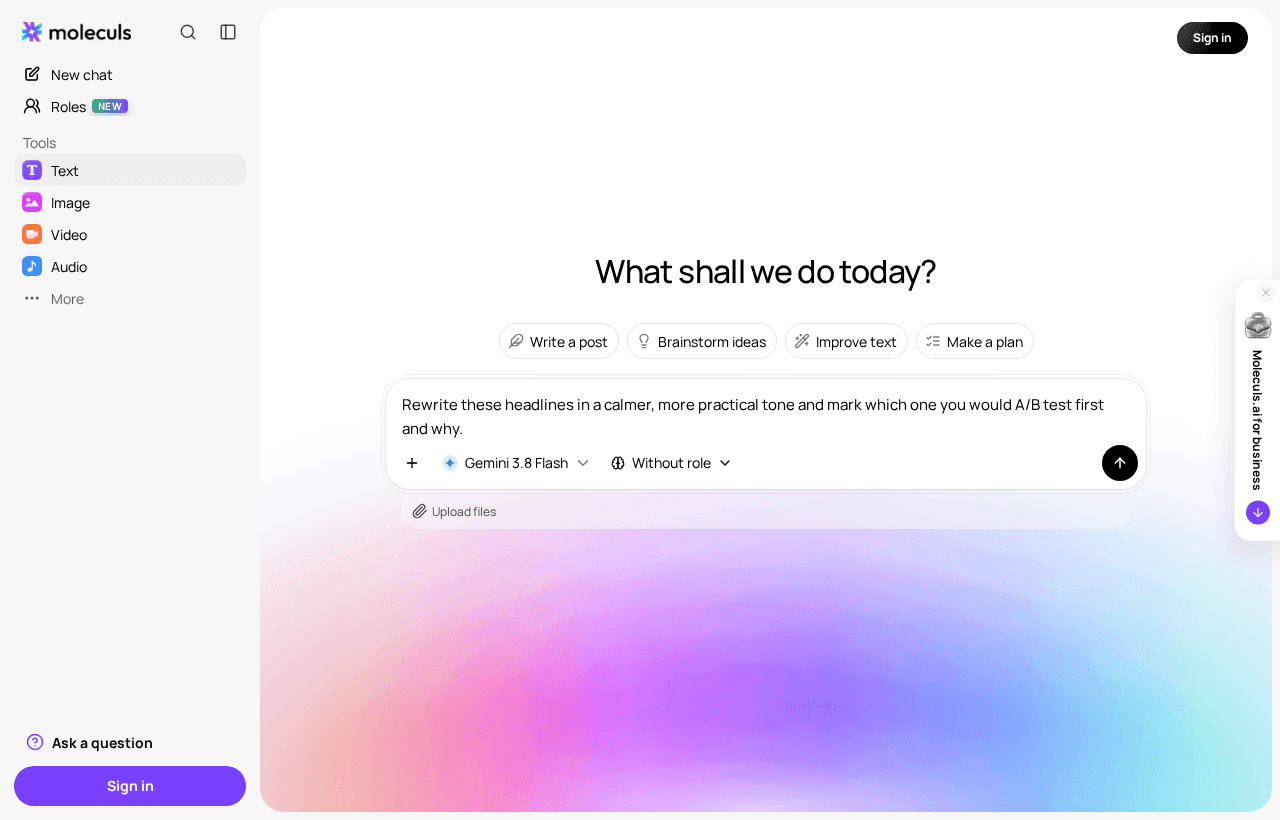
Don't write "make it better": the model will just add adjectives. Say exactly what's wrong. If the third round is still off, the problem is the brief, not the wording. Go back and fix the AUDIENCE or OFFER slot.
Which model to use for which copy task: comparison table
Costs are per run, as of October 2026. Prices change, so compare text models and their credit costs before you build a workflow.
| Task | Start with | Credits per run | Why this tier |
|---|---|---|---|
| Bulk headline variants | ChatGPT 6 Luna, DeepSeek V4 Flash, GLM 4.7 Flash | 1 | Cheap enough to rerun ten times |
| Hooks and captions | Gemini 3.8 Flash, DeepSeek V4 Pro | 2 | Short output, many attempts |
| Voice edits against a style guide | Claude Haiku 4.5 | 5 | Accepts files and up to 20 images, such as screenshots of past ads |
| Landing pages, email sequences | Claude Sonnet 5, ChatGPT 6 Sol | 10 | Long structure, fewer runs |
| Final pass on a high-stakes page | Gemini 3.1 Pro, Claude Opus 5.5 | 12 / 20 | One careful run, not ten |
| Competitor research before writing | Perplexity Sonar Deep Research | 8 | Web research with cited sources |
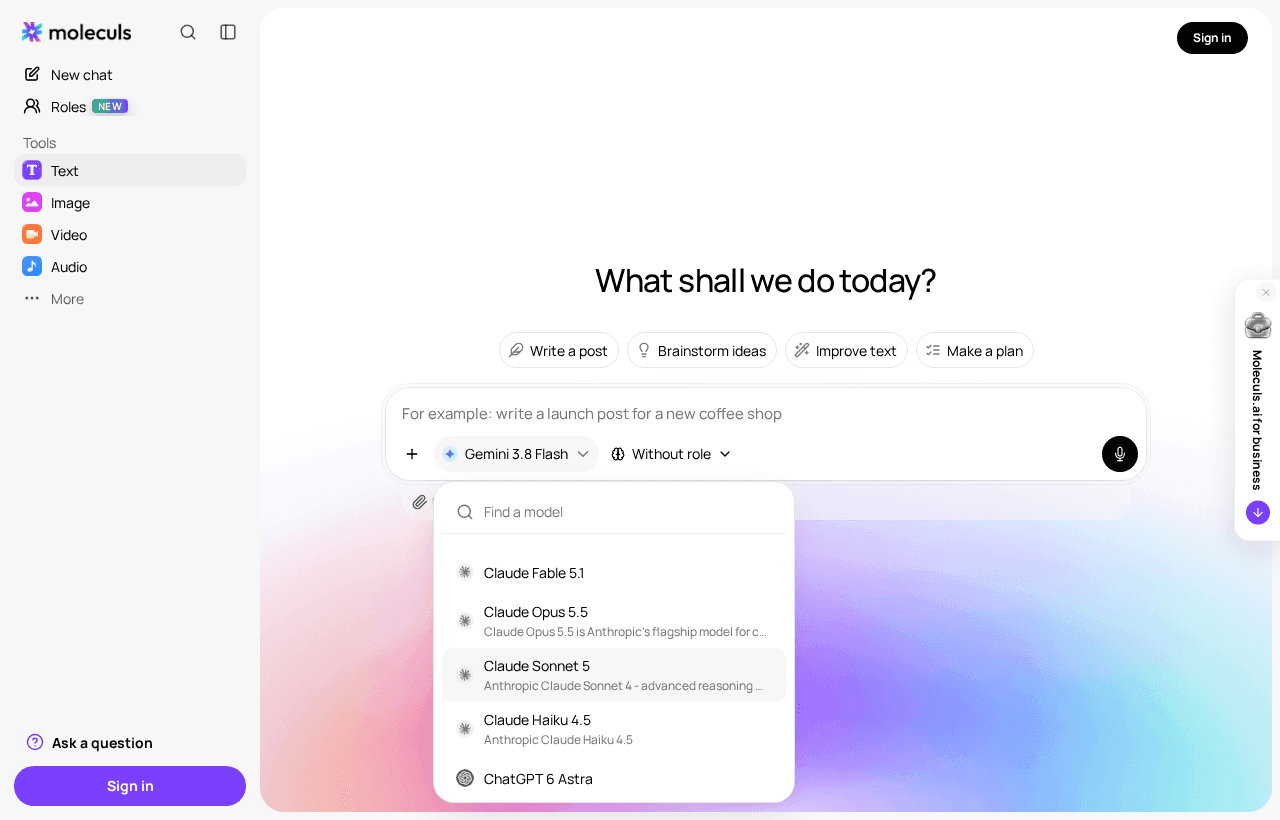
To choose for your own product, run the same filled template on two models, three times each. Keep the one whose output you edit least. A wrong pick has a clear cost: one run of ChatGPT 6 Astra (48 credits) on a headline task costs the same as 48 runs of a 1-credit model.
Running the templates in Moleculs: a step-by-step workflow
- Fill in the skeleton and the voice block in a doc first. Editing there is free, and rerunning a half-filled prompt isn't.
- Pick a text model from the table. For short copy, start with models that cost 1-2 credits.
- Paste the voice block and the template as one message. Attach the style guide if the model accepts files.
- Send follow-ups in the same conversation.
- To compare models, run the same prompt again on the second model. Moleculs doesn't show answers side by side, so copy both results into one doc.
- Count characters, check every claim against your real offer, and read the copy aloud before it goes into your ad account.
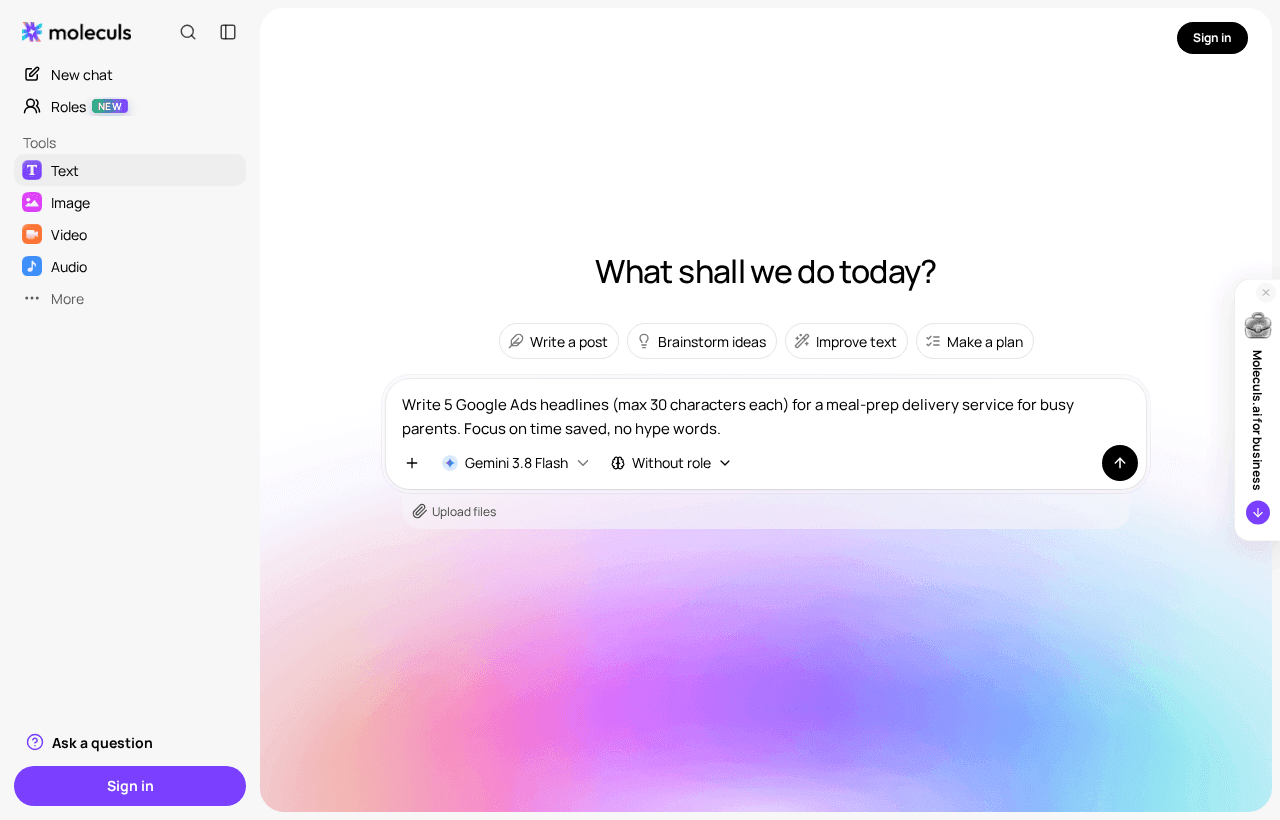
A free account comes with 5 credits, which covers five runs on 1-credit models. To see the workflow on a real brief, run the meal-prep headline prompt, then send the calmer-tone follow-up from above. For other tasks, browse more ready-made AI prompts.
Frequently asked questions
Related articles
How to Write AI Prompts: the Five-Block Formula
A five-block prompt formula with before-and-after examples, format-specific rules for images, video and audio, and ready-to-copy templates.
AI Photo Editing: What Works, What Fails, How to Prompt It
A practical look at AI photo editing: which tasks models handle well, how to write an editing prompt that protects the rest of the frame, and how to keep token spend low.
 Prompts
AI Image Prompts That Actually Work: Structure and Examples
A six-part prompt structure, before-and-after examples for photos, posters and product shots, and how to adapt one prompt for Midjourney, Flux or Ideogram.

Corporate access to AI models
Invoice for legal entities, centralised payment, priority support
- Access to ChatGPT, Gemini, Grok, Claude and DeepSeek
- Prompt library and shared access inside the team