
DeepSeek and Gemini as Codex Alternatives: What Actually Works
If you want a model other than Codex for coding, start with DeepSeek V4 Pro for reviews, bug hunts and short scripts. Switch to Gemini 3.1 Pro or Gemini 4 Argon when the task spans several files or the bug is easier to show than to describe. None of these models is an agent. Each reads only the code you hand it and answers in chat. You apply the changes and run the tests yourself.
Testing this is cheap. As of November 2026, a DeepSeek V4 Pro run costs 2 credits and a Gemini 3.1 Pro run costs 10. To check it on your own code, run DeepSeek online on a function with a bug you already know about. If the model finds that bug without hints, you have your first data point.
Short answer: which model to try instead of Codex, and for which tasks
- Reviewing a diff or a single file: DeepSeek V4 Pro. At 2 credits you can rerun it with a sharper prompt without thinking twice.
- One-off scripts, regex, shell commands, explaining a stack trace: DeepSeek V4 Flash, 1 credit per run.
- Several files at once, where names and types have to stay consistent across modules: Gemini 3.1 Pro or Gemini 4 Argon.
- A UI bug you can screenshot or record: any model in the table below that accepts images or video. Send the same capture to DeepSeek V4 Pro and Gemini 3.1 Pro and keep whichever reads it more precisely.
- A risky refactor, where a wrong answer costs you an afternoon: Claude Opus 5.5 as a second opinion.
Agent vs chat: what Codex does that a chat model won't do for you
Codex is OpenAI's coding agent. It works inside a repository: it reads files, runs commands and prepares changes for you to review. A chat model gets none of that. In practice, four things change:
- Context is your job. The model sees what you paste or attach and nothing else. If the helper function or the config file is missing, the model guesses, and the guess sounds as confident as a real answer.
- Nothing gets executed. The model can't run your code, so a claim like "this passes all tests" is a prediction, not a result.
- You apply the changes. Ask for a unified diff or a full replacement function, not loose snippets.
- You drive the loop. Run the tests, paste the failure back, ask for a fix.
For reviews, explanations and design questions, nothing is lost. Those tasks never needed shell access.
DeepSeek V4 Pro and V4 Flash for code: reviews, bug hunts, quick scripts
Both models accept files, images, video and audio. Pro costs 2 credits per run and Flash costs 1.
Reviews
Attach the file and give the model a narrow brief. "Review this" gets you a list of style nitpicks. "Find bugs and unhandled edge cases, ignore style" gets you findings. Check one thing: every finding should point to a line that exists in your file.
Bug hunts
Send three things together: the function, the full error output, and what you expected to happen. Without the expected behaviour, the model fixes the symptom. Library versions are a common trap: the model suggests an API from a different release. Put the versions in the first line of the prompt.
Quick scripts
Flash is enough here. Run the result on a small input before you trust it on real data. For comparisons with other assistants, see how DeepSeek compares with ChatGPT for coding. If you'd rather not write prompts from scratch, start with these ready-made DeepSeek prompts.
Gemini 3.1 Pro, Gemini 4 Argon and the Flash models: long files and screenshots
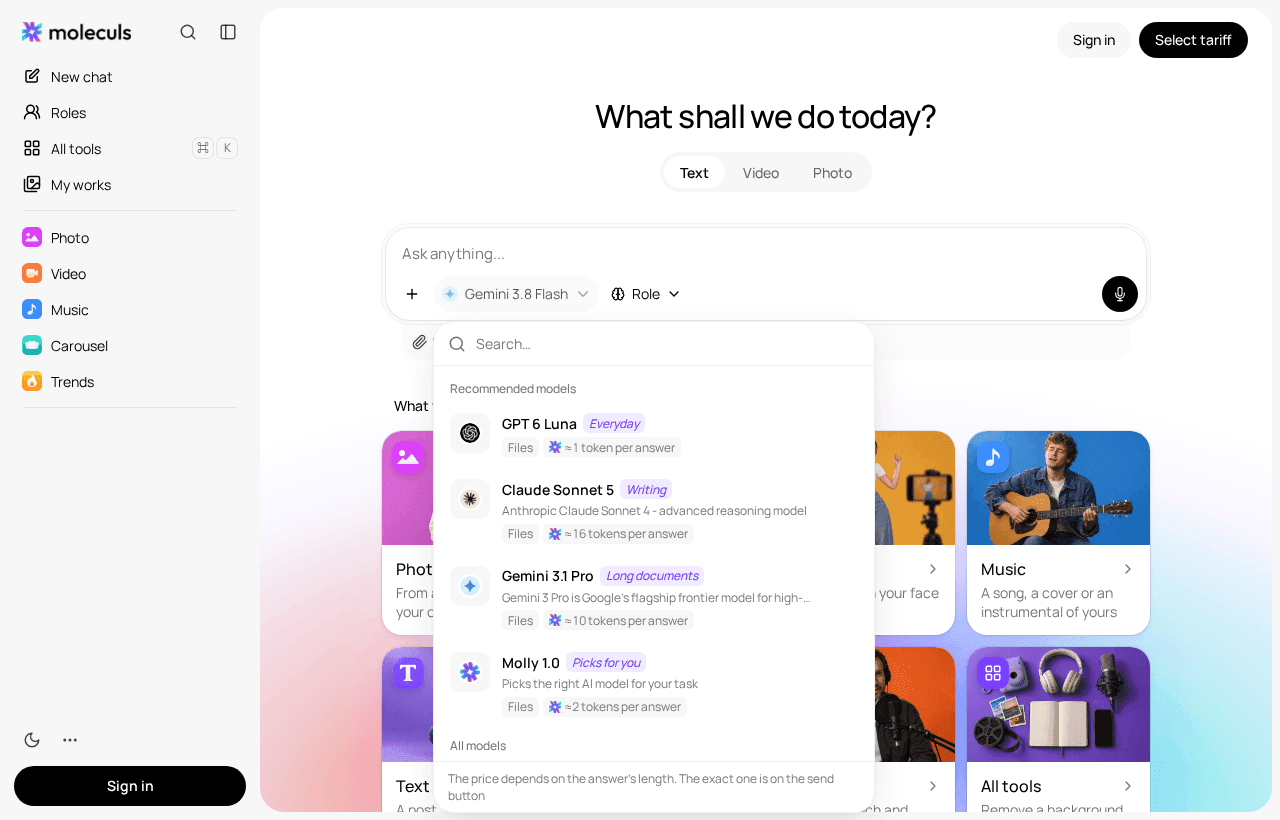
Gemini 3.1 Pro and Gemini 4 Argon cost 10 credits per run. Both accept up to 16 images, plus video, audio and files. The Flash models are cheaper: Gemini 3.8 Flash costs 2 credits and takes the same input types, and Gemini 3.7 Flash costs 4. Gemini 3.1 Flash Lite also costs 2 but takes only images and files.
Use the two 10-credit models when the answer depends on code spread across files. Attach the module, its callers and the types file, then ask the model to trace one value from input to output. To check the answer, ask the model to name the functions and files it relied on. If it names something that isn't in your files, it has lost track of the context, and its other conclusions can't be trusted either.
For screenshots, pair the image with the component code. A screenshot alone gets you generic advice about CSS.
Comparison table: DeepSeek vs Gemini vs other coding models
Prices are as of November 2026. The full model catalogue shows current prices and input types.
| Model | Credits per run | Inputs besides text | Try it for |
|---|---|---|---|
| DeepSeek V4 Flash | 1 | images, video, audio, files | scripts, error explanations |
| DeepSeek V4 Pro | 2 | images, video, audio, files | reviews, bug hunts, tests |
| Gemini 3.8 Flash | 2 | images, video, audio, files | cheap second opinion |
| Gemini 3.1 Flash Lite | 2 | images, files | short questions with a file |
| Gemini 3.7 Flash | 4 | images, video, audio, files | mid-size files |
| Gemini 3.1 Pro | 10 | images, video, audio, files | multi-file tracing, recordings |
| Gemini 4 Argon | 10 | images, video, audio, files | same tasks, check against 3.1 Pro |
| GLM 5.2 | 4 | none, paste code | complex tasks on pasted code |
| Grok 4.7 | 6 | images, files | code with long context |
| Qwen 3.8 Max | 7 | none, paste code | step-by-step reasoning |
| Claude Opus 5.5 | 13 | images, files | hard refactors |
| Kimi K3 | 15 | images | very long pasted context |
Step by step: moving typical Codex tasks into a chat workflow
- Shrink the task. One function, one diff or one failing test. "Fix the repo" doesn't fit in a chat.
- Collect the context. The target file, the files it imports from your project, your language and framework versions, and the exact error output.
- Fill in the template below. Without the Constraints line, the model renames things and adds dependencies.
- Ask for output you can apply. A list of problems, the full fixed function and a unified diff.
- Apply the change and run the tests yourself. Paste failures back. Stop after three rounds. If the code still fails, split the task or switch models.
Role: You are a senior Python reviewer. You see only the files I attach.
Task: Find bugs and unhandled edge cases in parse_log.py, then fix them.
Context: Python 3.12, pytest 8, standard library only. Input files can be several GB.
Format: 1) numbered problems with line numbers; 2) full fixed function; 3) unified diff.
Constraints: Keep public names. No new dependencies. If the answer depends on code
you can't see, say so instead of guessing.Here is how typical Codex requests translate:
- "Fix the failing test": paste the test, the function and the pytest output.
- "Add tests": first ask for a list of cases, cut the ones you don't need, then ask for the test file.
- "Refactor X": ask for a plan, then one diff per step.
- "Explain the codebase": this transfers poorly. Attach the entry point and the README, and expect a partial picture.
To compare models, send the identical prompt to DeepSeek V4 Pro and Gemini 3.1 Pro, one after the other. Moleculs has no side-by-side view, so save both answers to a file. Judge them on four points: does the code run, do the tests pass, did the model change only what you asked, and did it invent any APIs. For a ready test case, run the log deduplication prompt. Watch how the model handles memory. A hash set grows with the number of unique lines, so an answer that calls it constant-memory is wrong.
Count what a failed attempt costs. Three rounds on Gemini 3.1 Pro take 30 credits. Three rounds on DeepSeek V4 Pro take 6. The free plan's 5 credits cover two DeepSeek V4 Pro runs. Paid plans include between 1,000 and 20,000 credits a month, and the plans page lists the current options.
Other DeepSeek alternatives worth testing: Claude Opus 5.5, GLM 5.2, Grok 4.7, Kimi K3, Qwen 3.8 Max
- Claude Opus 5.5, 13 credits. Anthropic's flagship for reasoning and code. It takes up to 20 images and accepts files. Use it as a tiebreaker when DeepSeek and Gemini disagree.
- GLM 5.2, 4 credits. Z.ai's flagship model. It has no file input, so paste the code as text.
- Grok 4.7, 6 credits. xAI positions it for code and long context. It accepts images and files.
- Kimi K3, 15 credits. Moonshot AI's reasoning model with a 1M-token context. It accepts images but not files, so long code has to be pasted.
- Qwen 3.8 Max, 7 credits. Alibaba's extended reasoning mode. Text only.
Don't test all five. Pick one as your second opinion and run it on the same three tasks you used for DeepSeek. There is a closer look at Kimi vs DeepSeek and Qwen.
Limits to know before you switch
- No repo access. The model sees only the files you attach. Remove API keys, tokens and connection strings before you paste anything.
- You run the tests. Treat every "this works" as unverified until your test runner says so.
- Behaviour may differ from the vendor's app. In Moleculs, settings and system wrapping can differ from the vendor's own interface. Two different answers to the same prompt don't mean you got a different model.
- Large multi-file changes don't transfer well. A rename across forty files is a job for an agent or your IDE's refactoring tools, not for a chat.
Frequently asked questions
Related articles
 Model guides
Free ChatGPT, Gemini and Grok Alternatives: What Actually Works
Which free AI chatbots can replace ChatGPT, Gemini or Grok, what their free plans skip, and how to test several models before you pay for one.
 AI explained
What Is an AI Aggregator and When Do You Actually Need One?
How an AI aggregator gives you text, image, video and audio models in one subscription, what it can't do, and a simple test to see if you need one.
What Is a Neural Network in Plain Words and How It Works
A plain-language walkthrough of what a neural network is, how it learns, why it invents facts, and a short experiment you can run on a text model yourself.

Corporate access to AI models
Invoice for legal entities, centralised payment, priority support
- Access to ChatGPT, Gemini, Grok, Claude and DeepSeek
- Prompt library and shared access inside the team