
Is Kimi Free to Use? What You Get for Free and Where Limits Start

Yes, Kimi is free to use, with limits. Moonshot AI, the company behind it, offers free access in its own app. It has also released some Kimi models as open models, so other platforms can host them. On each route "free" means something different: a cap on messages, a lighter model, or a small credit quota.
Below: what each free route gives you, how Claude and ChatGPT compare, and what a 5-credit quota buys if you want to use Kimi online next to the other two.
Short answer: yes, Kimi can be used for free, with limits
You can start today without paying. You can't get unlimited use of the strongest model. Free options tend to limit you in three ways:
- Usage caps. After a certain number of messages, you wait or upgrade.
- Model access. The newest or heaviest model is often kept for paid users.
- Input size. Long files and big pastes hit limits sooner than short questions.
If you need a few answers a day, free access is usually enough. If you give Kimi long documents or use it daily, you'll reach the limit within a few sessions.
What "free" means for Kimi: Moonshot AI's own app, open models and third-party platforms
There are three ways to use Kimi without paying, and they work differently.
Moonshot AI's own app
This is the official Kimi app. It has a free option with usage limits, and Moonshot AI changes those limits over time. Check Kimi's own site for current terms instead of trusting numbers from older reviews.
Open models
Moonshot AI has released some Kimi models with open weights. Kimi K2 Thinking, for example, is described as an open reasoning model. "Open" means free to download, not free to run. A model this size needs serious server hardware, so few people run it at home.
Third-party platforms
Because the weights are open, other services can offer Kimi through their own interface. They usually give you a small free allowance, then charge per request or by subscription. The model family is the same, but the settings around it can differ, so an answer may not match the official app word for word.
Is Claude free to use? What the free option usually covers
Yes. Anthropic has a free tier for Claude. It usually covers:
- Chat with a current Claude model, within a message cap that resets over time.
- Pasting text and attaching files, with tighter limits than on paid plans.
When you hit the cap, you wait for the reset. Paid plans give you more usage, more models and priority when demand is high. Anthropic changes the details often, so check its site before deciding.
A long conversation with large attachments eats the free cap faster than many short questions. If you plan to give Claude a 40-page report, expect to run out partway through.
Is ChatGPT free to use? What the free option usually covers
Yes. OpenAI has a free ChatGPT tier with limits on usage and features. It usually works like this:
- You get a limited number of messages on the more capable model.
- After that, ChatGPT switches you to a lighter model until the limit resets.
- Some tools and heavier features are limited or only available on paid plans.
The switch to a lighter model is easy to miss. If answers get shorter or shallower partway through a session, you've probably hit the cap. Paid plans raise the limits and open up more models and tools.
Kimi vs Claude vs ChatGPT: free access compared
| Kimi | Claude | ChatGPT | |
|---|---|---|---|
| Free option exists | Yes: official app, plus open models on third-party platforms | Yes: free tier from Anthropic | Yes: free tier from OpenAI |
| Typical limits you hit | Usage caps; the newest model may be restricted | Message cap that resets over time; tighter limits on long inputs | Cap on the stronger model, then a switch to a lighter one |
| What paying changes | Check the vendor's current terms | More usage, more models, priority access | Higher caps, more models and tools |
Vendor prices change and differ by region, so check each vendor's own pricing page.
How to try Kimi for free in Moleculs, step by step
Moleculs is an aggregator: one interface for models from different vendors, including Kimi, Claude and ChatGPT. It builds none of these models, and a model here may not behave exactly like the vendor's own app. This order wastes the fewest credits.
- Send one guest request. You don't need an account. A guest can send one request and get an answer from a text model, which is enough to see how the chat works.
- Create a free account. The free plan comes with a 5-credit quota. Each model's cost per run appears next to the model and in the catalog.
- Choose your Kimi model before you type. Kimi K2 Thinking costs 3 credits per run and Kimi K2.6 costs 4. The next section helps you pick.
- Write one complete prompt. A run you have to redo costs the full price again, and with 5 credits a vague prompt can burn most of your quota.
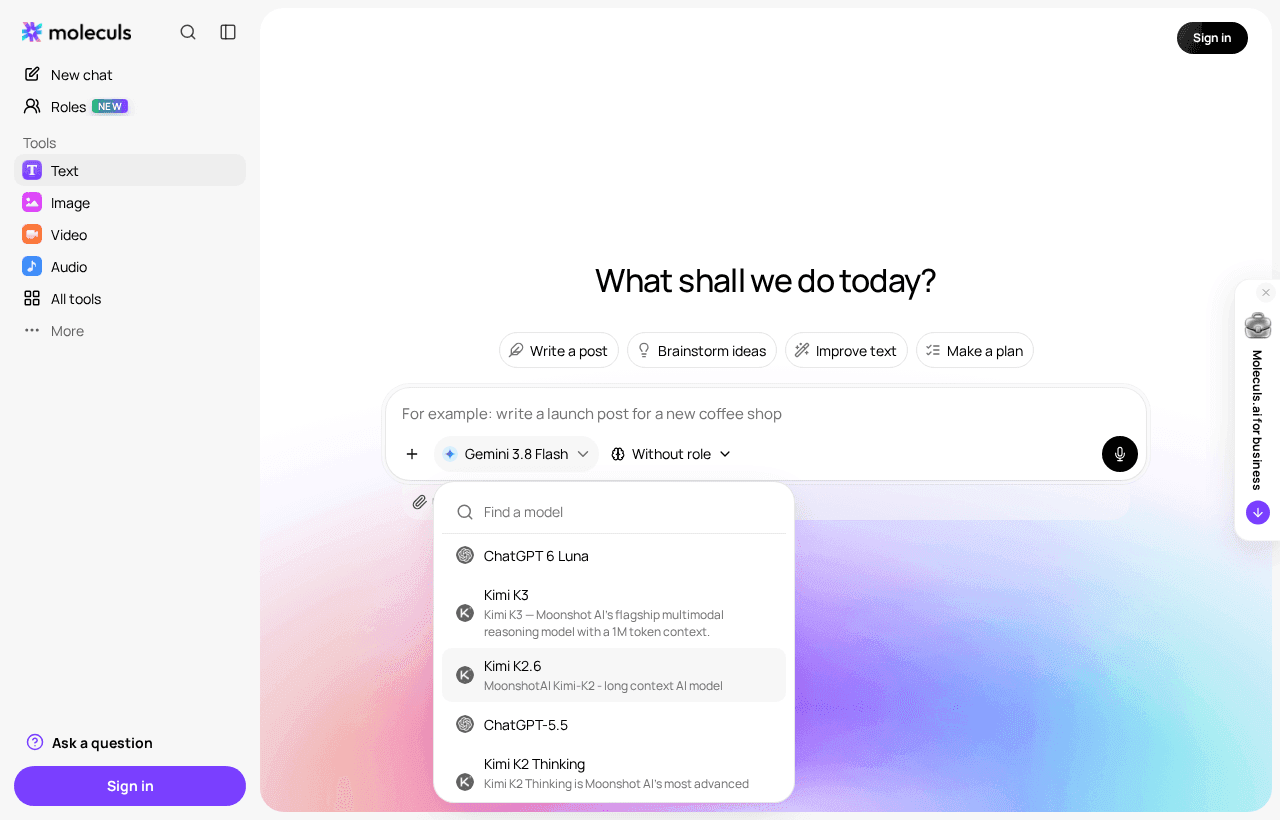
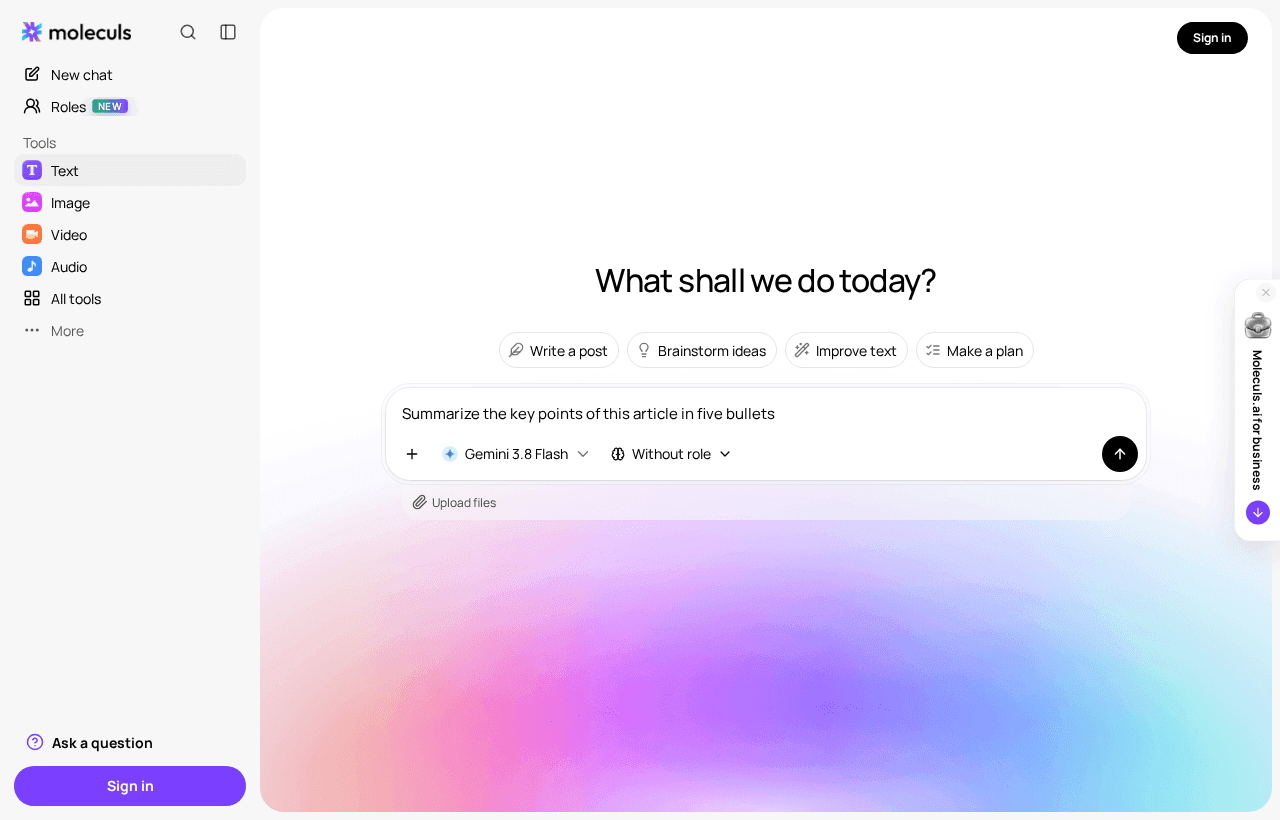
This structure gives you a first run you can judge:
Role: You are a practical assistant who explains trade-offs plainly.
Task: Compare Kimi, Claude and ChatGPT for everyday work tasks.
Format: A short table (strengths, weak spots), then three tasks where Kimi should be my first pick, one line each.
Limits: Under 250 words. No marketing language. If you are unsure about something, say so.Replace the task with your own. The "Limits" line does the most work: it keeps the answer short and tells the model to flag uncertainty instead of guessing.
Then check three things. Did the answer follow the format? Did it stay under the word limit? Did it admit uncertainty anywhere, or sound sure about everything? If it missed two of the three, change the prompt before you spend another run. If you don't want to write your own yet, run a ready-made comparison prompt.
What 5 free credits buy
These are per-run costs as of October 2026. The current numbers always appear next to each model.
| Model | Credits per run | Fits in 5 credits |
|---|---|---|
| ChatGPT 6 Luna | 1 | Yes, up to five runs |
| Kimi K2 Thinking | 3 | Yes, one run |
| Kimi K2.6 | 4 | Yes, one run |
| Claude Haiku 4.5 | 5 | Yes, uses the whole quota |
| Kimi K3 | 15 | No |
Some combinations that fit:
- Kimi K2.6 + ChatGPT 6 Luna (4 + 1). Send the same prompt to both and compare.
- Kimi K2 Thinking + 2 runs of ChatGPT 6 Luna (3 + 1 + 1). Refine your prompt on the cheap runs, then spend 3 credits on Kimi.
- Claude Haiku 4.5 alone (5). One answer, and the quota is gone.
To choose between the two Kimi models, look at your input. Kimi K2 Thinking is a reasoning model built for multi-step problems, but it doesn't take images. Kimi K2.6 accepts up to 10 images per request. Neither takes file attachments, so paste the text directly. Kimi K3 is Moonshot AI's flagship multimodal reasoning model with a 1M-token context. At 15 credits per run, it doesn't fit in the free quota. For a broader look at the model family, see what Kimi AI can actually do.
When free stops being enough: long documents, heavy reasoning, daily use
Three situations tell you the free quota is no longer enough:
- Long documents. The Kimi models that fit in the free quota don't take files, so you have to paste text. The 1M-token context belongs to Kimi K3, at 15 credits per run. Claude Haiku 4.5 accepts files, but one run uses the whole free quota.
- Heavy reasoning. Hard problems often need a retry. At 3-4 credits per run, the free quota runs out on the first one.
- Daily use. Five credits is one session, not a week.
The smallest paid quota is 1,000 credits per month as of October 2026, and it renews each paid period. That's about 66 runs of Kimi K3 or about 250 runs of Kimi K2.6. Check the pricing page for current plans, and read the terms of use before you pay.
Don't jump straight to the biggest plan. Use your free credits to find out which model handles your task well, work out how many runs a typical week takes, and choose a plan from that number.
Frequently asked questions
Related articles
 Model guides
What Can Kimi AI Do? A Practical Guide to Moonshot AI's Models
Kimi K3, K2.6 and K2 Thinking compared: which tasks each one handles, what Kimi can't do, and when Midjourney is the better tool.
 AI explained
What Is an AI Aggregator and When Do You Actually Need One?
How an AI aggregator gives you text, image, video and audio models in one subscription, what it can't do, and a simple test to see if you need one.
What Is a Neural Network in Plain Words and How It Works
A plain-language walkthrough of what a neural network is, how it learns, why it invents facts, and a short experiment you can run on a text model yourself.

Corporate access to AI models
Invoice for legal entities, centralised payment, priority support
- Access to ChatGPT, Gemini, Grok, Claude and DeepSeek
- Prompt library and shared access inside the team